
Eugène Delacroix: The Architect of Romantic Color and the Journal of a Restless Painter
Eugène Delacroix (1798–1863) was the leading painter of French Romanticism, admired for his rich color, his dramatic compositions and his belief that imagination matters more than rules. He also kept a famous Journal, in which he wrote down, day after day, his doubts, his reading, his memories and his thoughts on painting.
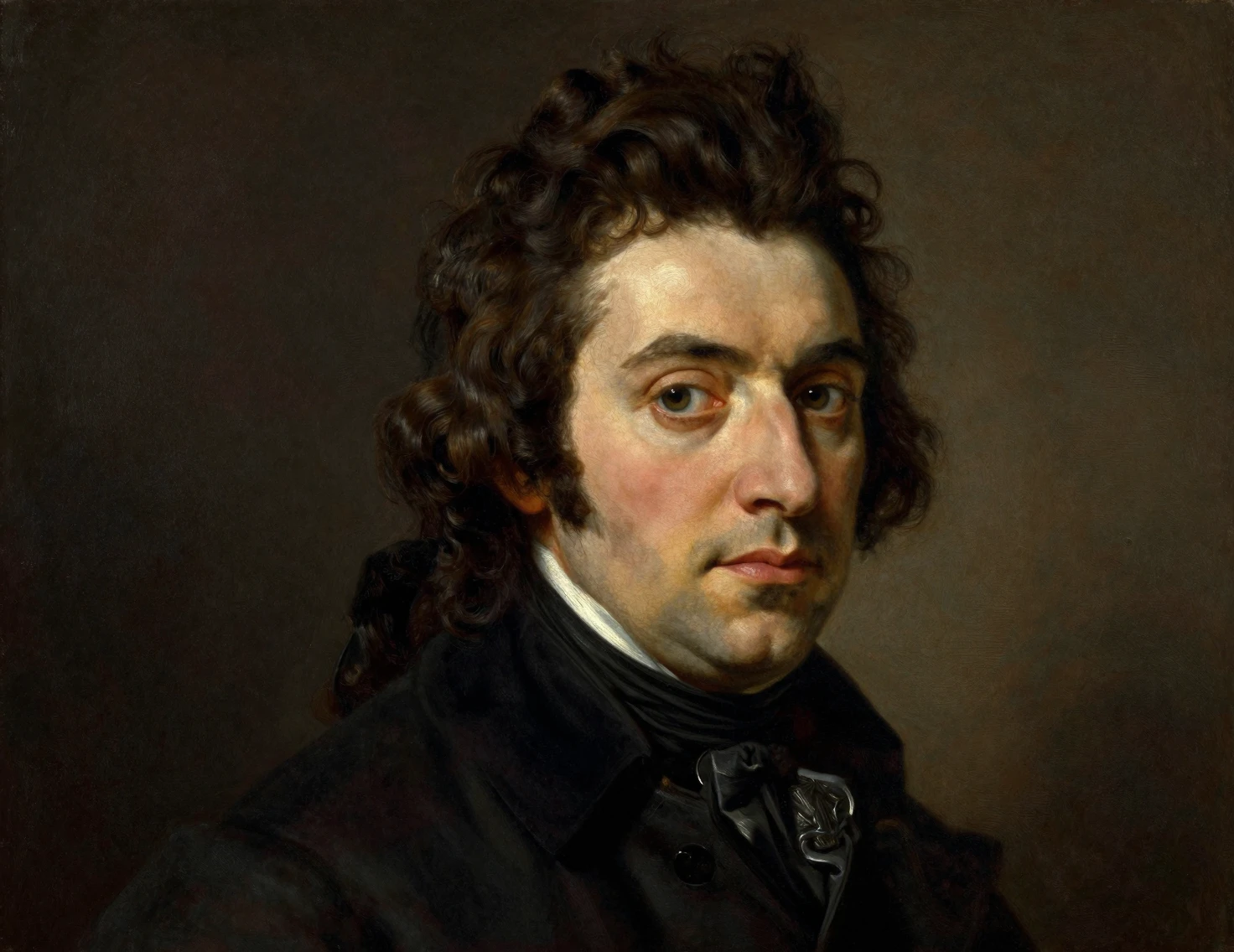
The sentences below follow a young painter who copies the masters, fights against cold, reasonable painting and tries to pass his feelings to the viewer. If you like artists' own words, read also Francisco de Goya, Michelangelo and Élisabeth Vigée Le Brun on Quotyzen.
This collection contains 17 sentences, all taken from the Journal de Eugène Delacroix, Tome premier, 1823–1850, edited by Paul Flat and René Piot (Plon, 1893), as published on Project Gutenberg (eBook #54020). Delacroix wrote in French, and the sentences are quoted here in the original French, exactly as printed. The short English explanation that opens each comment is our own rough rendering, not a published translation.
17 Quotes from Eugène Delacroix
Painting, Thought and Imagination
“Quand j'ai fait un beau tableau, je n'ai point écrit une pensée.”
In English, roughly: when he has made a fine painting, he has not written a single thought. He is answering people who say that a picture must carry an idea, as a book does. The sentence is short and almost defiant, and it shows how firmly he separated painting from literature, even though he read widely.
“Dans la peinture, il s'établit comme un point mystérieux entre l'âme des personnages et celle du spectateur.”
In English, roughly: in painting there arises a mysterious bridge between the souls of the figures and the soul of the spectator. Here Delacroix explains what he thinks painting does better than writing. A writer says almost everything to be understood, while a painter lets the viewer complete the thought through feeling and silence.
“Je pense que c'est l'imagination seule, ou bien, ce qui revient au même, cette délicatesse d'organes qui fait voir là où les autres ne voient pas, et qui fait voir d'une façon différente.”
In English, roughly: he thinks it is imagination alone, or what comes to the same thing, a delicacy of the organs that lets a person see where others do not, and see in a different way. He is recording a discussion with friends about genius. For him, extraordinary people are defined by a way of seeing.
“Mais tant que mon imagination sera mon tourment et mon plaisir à la fois, qu'importe le bien ou non?”
In English, roughly: as long as his imagination is both his torment and his pleasure, what does it matter whether things are good or not? Imagination for him is double-edged. It makes him suffer and it makes his work possible, so he accepts the cost without hoping for a calmer, more comfortable life.
“Je crois éprouver que ce dernier me serait peut-être plus interdit que l'autre; tout travail où l'imagination n'a pas de part m'est impossible.”
In English, roughly: he believes he would find this last kind of work even more forbidden to him than the other, because any work in which imagination has no part is impossible for him. He is comparing the kinds of labour he can bear. Whatever he does must involve invention, or he cannot do it at all.
“Ce qu'il y a de plus réel en moi, ce sont ces illusions que je crée avec ma peinture.”
In English, roughly: the most real thing in him is the illusions he creates with his painting. In the next sentence he adds that the rest is shifting sand. The line is often quoted because it reverses the usual order: for Delacroix, the world of the picture is firmer than everyday life.
The Painter at Work
“Je voudrais étaler sur une toile brune ou rouge de la bonne grasse couleur et épaisse.”
In English, roughly: he would like to spread good, fat, thick colour on a brown or red canvas. The mood is physical and impatient, like a man who longs to take up his palette. It shows how much of his painting began as an appetite for paint itself, before any subject was chosen.
“Je n'aime point la peinture raisonnable; il faut, je le vois, que mon esprit brouillon s'agite, défasse, essaye de cent manières, avant d'arriver au but dont le besoin me travaille dans chaque chose.”
In English, roughly: he does not like reasonable painting. His restless mind must stir, undo and try a hundred ways before reaching the goal that every task makes him need. The sentence shows how he worked, by trial, revision and tension rather than by a calm plan, and how he accepted that turmoil as part of his talent.
“La peinture, je me le suis dit mille fois, a ses faveurs, qui lui sont propres à elle seule.”
In English, roughly: painting, as he has told himself a thousand times, has its own favours, which belong to it alone. The next lines turn to the poet, whom he calls very rich, and recall passages of Byron that stir him. Delacroix often compared the arts, and here he insists that painting offers pleasures no other art gives.
“Sitôt que la sueur commence à me gagner et mon sang à s'impatienter, tiens-toi en garde: la peinture lâche est la peinture d'un lâche.”
In English, roughly: as soon as the sweat starts to take hold of him and his blood grows impatient, he tells himself to be on guard, because loose painting is the painting of a coward. It reads like a note addressed to himself, a reminder to work with calm and control rather than with feverish haste.
“Mais, du moins, que j'éprouve, autant que possible dans chacune de mes peintures, ce que je veux faire passer dans l'âme des autres!”
In English, roughly: let him at least feel, as far as possible in each of his paintings, what he wants to pass into the souls of others. The exclamation comes after he regrets that he is not a poet. It sums up his aim: a painting should transmit an emotion from the painter to the viewer, not just describe a scene.
“Dans un tableau, de même: les incorrections, les gaucheries me sautent aux yeux; je juge ma peinture comme si j'étais un autre que moi-même.”
In English, roughly: in a painting it is the same: the faults and awkward places leap out at him, and he judges his own work as if he were someone else. Just before, he describes correcting a piece of writing at once after a pause. It is a strong statement of the distance an artist needs from his own work.
Seeing, Feeling and the Masters
“J'écris ce blasphème propre à faire dresser les cheveux de tous les hommes d'école, sans prendre décidément parti; seulement je trouve en moi, à mesure que j'avance dans la vie, que la vérité est ce qu'il y a de plus beau et de plus rare.”
In English, roughly: he calls this a blasphemy that would make every academic's hair stand on end, yet he finds that truth is the most beautiful and rarest thing. The editor places it in a comparison of Rembrandt and Raphael. Delacroix does not take sides decisively; he only records, with some mischief, how his own taste is moving as he grows older.
“Il lisait les journaux, moi je pris quelques traits des Michel-Ange que j'ai apportés avec moi: la vue de ce grand dessin m'a profondément ému et m'a disposé à de favorables émotions.”
In English, roughly: while someone reads the newspapers, he sketches a few lines after the Michelangelos he brought with him, and the sight of that great drawing moves him deeply and puts him in the mood for good feelings. It is an early glimpse of the habit he kept all his life, learning by copying the masters.
“Ce bonheur était peu vif quand je le possédais, aujourd'hui il se colore par mon imagination; c'est elle qui fait mes douleurs et mes joies.”
In English, roughly: this happiness was not very lively when he had it, but now it takes on color through his imagination, which is what makes both his sorrows and his joys. The sentence is a good example of the Journal as self-examination. Memory and imagination colour the past more strongly than the moment itself did.
“Notez que je ne prends qu'un instant: l'oiseau se plonge dans l'eau; je vois sa couleur, le dessous argenté de ses petites ailes, sa forme légère, les gouttes d'eau qu'il fait voler au soleil, etc.”
In English, roughly: he takes only a single instant. The bird plunges into the water, and he sees its colour, the silvery underside of its small wings, its light shape and the drops it throws into the sun. He is describing what a painter can capture at a glance, and what a writer would need pages to list.
“Ici est l'impuissance de l'art du poète; il faut que de toutes ces impressions il choisisse la plus frappante pour me faire imaginer toutes les autres.”
In English, roughly: this is where the poet's art is powerless. From all these impressions he must choose the most striking one, to make the reader imagine the others. Delacroix has just described a bird bathing in many small details, and he concludes that painting shows many things at once while poetry must select.
Conclusion
Read together, these sentences show a painter who trusts imagination, distrusts calm rules and judges his own work without mercy. He loves the thick, physical side of paint, yet he also thinks about what a picture should make the viewer feel. The Journal lets us see both sides in the same few pages.
The entries also show how much he learned from other arts and other artists. He compares painting with poetry, studies Michelangelo and Rembrandt, and notes the small moments he wants to keep. For readers who know only his large paintings, these private sentences explain how his ideas took shape.
Frequently Asked Questions
Who was Eugène Delacroix?
He was a French painter (1798–1863), the leading figure of Romanticism in French painting, known for his use of color and for dramatic scenes inspired by history, literature and travel.
What is the Journal of Delacroix?
It is a set of notes he wrote from day to day, mixing observations on painting with memories, reading, travel and reflections on his own character. The first volume covers the years 1823 to 1850.
Why are the quotes in French?
Delacroix wrote in French, and the only text we quote is the printed original. Each comment begins with a short English rendering of our own, which is not a published translation.
Which text is quoted here?
All sentences are quoted from the Journal de Eugène Delacroix, Tome premier, 1823–1850, with a study by Paul Flat and notes by Paul Flat and René Piot (Paris: Plon, 1893), Project Gutenberg eBook #54020.
Recommended Similar Collections on Quotyzen
- Francisco de Goya: the first modern painter
- Michelangelo: the divine architect of the Renaissance
- Élisabeth Vigée Le Brun: the memoirs of a painter
Which of Delacroix's sentences speaks to you most? Share your view in the comments below!
Join the conversation