
Lord Byron: The Architect of the Byronic Hero and the Wit of Don Juan
George Gordon Byron, Lord Byron, was born in London in 1788 and died at Missolonghi, in Greece, in 1824. He became famous overnight with the first cantos of Childe Harold, left England in 1816 after a scandal, and lived in Italy and Greece, where he joined the Greek struggle for independence. His name gave the English language the phrase “Byronic hero.”
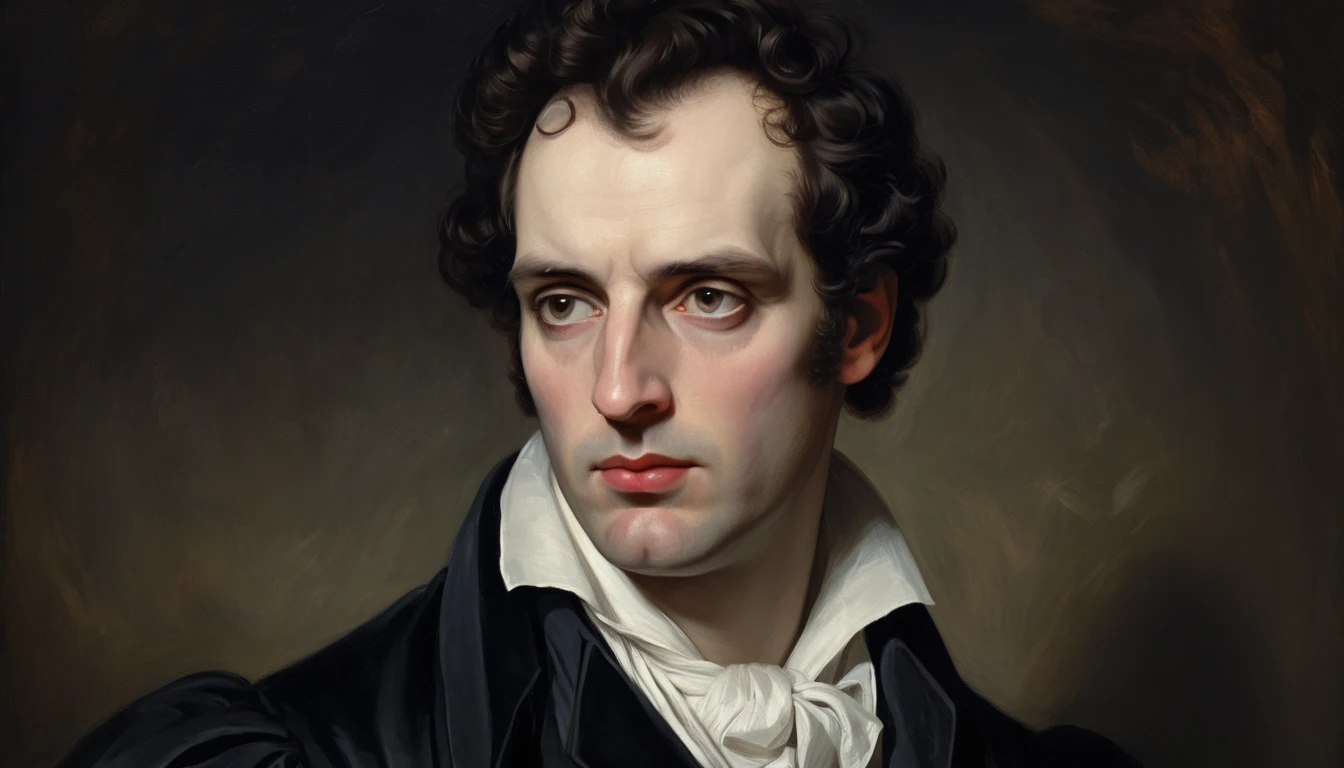
Don Juan, begun in 1818 and left unfinished at his death, is his longest and wittiest poem. It reverses the old legend: Juan is not a seducer but a handsome young man to whom things happen. The narrator, a lively and often cynical voice, interrupts the story to joke and moralise. Readers who enjoy Robert Burns, William Blake or Voltaire will find in Byron a poet who turns satire into sustained entertainment.
This collection contains 17 passages, copied exactly from Don Juan, in the public-domain Project Gutenberg edition (ebook 21700). Byron wrote in English, so no translator is involved. Most passages are the narrator’s voice, and three are from the letter that the character Julia writes. The edition prints Byron’s old-style spacing, as in “Man ’s,” and it prints verse as a run of lines, and both are kept. Some passages begin or end in the middle of a stanza.
17 Passages from Byron’s Don Juan
The Hero, the Heart and the Poet’s Voice
“I want a hero: an uncommon want, When every year and month sends forth a new one, Till, after cloying the gazettes with cant, The age discovers he is not the true one;”
This is the opening of Don Juan, Canto I. The narrator says that he needs a hero, and that the newspapers have already made too many new ones who turn out to be false. It is a joke against his time, and it announces the tone. He then chooses Don Juan, the old stage rake. The passage ends with a semicolon, in the middle of the stanza.
“A little still she strove, and much repented And whispering ‘I will ne’er consent’—consented.”
These lines from Canto I describe Donna Julia, the married woman who yields to the sixteen-year-old Juan. The two-line joke is the stanza’s whole effect. She says one thing and does another, and the rhyme of “repented” with “consented” gives the sentence its snap. It is an example of Byron’s trick of using the double rhyme for comedy.
“’Tis sweet to hear the watch-dog’s honest bark Bay deep-mouth’d welcome as we draw near home; ’Tis sweet to know there is an eye will mark Our coming, and look brighter when we come;”
In Canto I the narrator breaks off to list sweet things. This stanza begins with the sound of the watch-dog welcoming a traveller home. The tone is warm and plain, and is a respite from the satire. Byron wrote the poem in Italy, far from England, which may add to the feeling. The next stanzas go on with the vintage, the miser’s heap and revenge.
“Man ’s a strange animal, and makes strange use Of his own nature, and the various arts, And likes particularly to produce Some new experiment to show his parts;”
The narrator, still in Canto I, reflects on what people do with their own nature. The old edition prints a space in “Man ’s,” and the passage keeps it. The stanza is a witty observation on human oddity. Byron says that this is an age of oddities let loose. The following lines advise the reader to begin with truth and find there is a sure market for imposture.
Julia’s Letter
“Man’s love is of man’s life a thing apart, ’Tis woman’s whole existence; man may range The court, camp, church, the vessel, and the mart; Sword, gown, gain, glory, offer in exchange Pride, fame, ambition, to fill up his heart, And few there are whom these cannot estrange; Men have all these resources, we but one, To love again, and be again undone.”
Donna Julia writes this in her farewell letter to Juan, after their affair has been discovered and she has been sent to a convent. Her speech is a famous statement of the difference between men and women in love. It is written by a character in a moment of grief, so it is Julia’s view and not simply Byron’s. The passage begins after an opening quotation mark.
“You will proceed in pleasure, and in pride, Beloved and loving many; all is o’er For me on earth, except some years to hide My shame and sorrow deep in my heart’s core;”
This is the next stanza of Julia’s letter. She says that Juan will go on to a life of pleasure and many loves, while she will have only some years in which to hide her shame. The stanza is plain and moving, and it lets the poet show a real feeling inside a comic poem. The passage begins after an opening quotation mark and ends at a semicolon.
“Death shuns the wretch who fain the blow would meet, And I must even survive this last adieu, And bear with life, to love and pray for you!”
These are the last lines of Julia’s letter. She writes that she must survive the parting, because death avoids those who want it. The lines are sad, and the narrator’s next comment is a comic description of the note on gilt-edged paper. That change of tone, from grief to mockery, is how Byron often works. The closing quotation mark of the letter was left out.
Pleasure, Wine and Women
“Sweet is revenge—especially to women, Pillage to soldiers, prize-money to seamen.”
This couplet is part of the list of sweet things in Canto I, with the vintage, the miser’s heaps and the father’s first-born child. The humour comes from the dry list: revenge, pillage, prize-money. Each item names a pleasure that belongs to a different group. It is a comic way of saying that people want different things, and the narrator is a cynic.
“’Tis pleasing to be school’d in a strange tongue By female lips and eyes—that is, I mean, When both the teacher and the taught are young, As was the case, at least, where I have been;”
In Canto II the narrator describes how languages are best learned. The stanza is a comic digression about learning from young women. The phrase “that is, I mean” is a typical Byron aside, since the speaker corrects himself as if the reader were listening. The passage ends with a semicolon, and the next lines go on to speak of the pressure of hands and a chaste kiss.
“Man, being reasonable, must get drunk; The best of life is but intoxication: Glory, the grape, love, gold, in these are sunk The hopes of all men, and of every nation;”
The narrator, in Canto II, argues with a straight face that a reasonable man should get drunk. The stanza continues with advice for the morning after, with a valet, hock and soda-water. The argument is a joke, and also a candid list of what people live for: glory, wine, love and money. The comedy is in the logic.
“Alas! the love of women! it is known To be a lovely and a fearful thing; For all of theirs upon that die is thrown, And if ’tis lost, life hath no more to bring To them but mockeries of the past alone, And their revenge is as the tiger’s spring, Deadly, and quick, and crushing; yet, as real Torture is theirs, what they inflict they feel.”
In Canto II the narrator turns serious about women’s love. He says that they stake everything on one throw and that when it is lost their revenge is like a tiger’s spring. The stanza is one of the most vivid in the poem. It is the narrator’s opinion, and it is also a defence of women in a poem that often mocks them.
“In her first passion woman loves her lover, In all the others all she loves is love, Which grows a habit she can ne’er get over, And fits her loosely—like an easy glove,”
These lines come early in Canto III. The narrator says that a woman’s first passion is for a man, but that in her later passions she loves only love. The comparison with an easy glove is a typical Byron conceit, light and a little cruel. The passage ends with a comma, and the stanza goes on with an invitation to prove it.
Laughter, Truth and Time
“And if I laugh at any mortal thing, ’Tis that I may not weep; and if I weep, ’Tis that our nature cannot always bring Itself to apathy, for we must steep Our hearts first in the depths of Lethe’s spring, Ere what we least wish to behold will sleep:”
In Canto IV the narrator explains his own manner. He laughs so as not to weep, and if he weeps it is because human nature cannot reach apathy easily. It is one of the most quoted statements of the poem’s method. The passage ends with a colon in the middle of the stanza, which goes on with the story of Thetis and Achilles.
“Cervantes smiled Spain’s chivalry away; A single laugh demolish’d the right arm Of his own country;—seldom since that day Has Spain had heroes.”
This is from Canto XIII. The narrator says that Cervantes, with Don Quixote, destroyed Spain’s chivalry with a laugh, and that Spain has hardly had heroes since. It is a sweeping claim, and the narrator does not defend it in detail. The stanza ends by saying that Cervantes’s fame was bought at a high price. The passage ends in the middle of the stanza.
“Society is now one polish’d horde, Form’d of two mighty tribes, the Bores and Bored.”
The narrator, in Canto XIII, describes the English society that Juan has entered as a diplomat. He says that it consists of two tribes, the Bores and the Bored. It is a famous couplet, and the pun on the two words is the whole joke. The surrounding stanzas complain that professions and follies have become too polished to be worth gathering.
“’Tis strange,—but true; for truth is always strange; Stranger than fiction; if it could be told, How much would novels gain by the exchange! How differently the world would men behold!”
In Canto XIV the narrator says that truth is stranger than fiction, and that novels would gain if they could tell the true story. The first two lines have become a proverb in English. The stanza that follows imagines a Columbus of the moral seas who would show people the antipodes of their souls. The passage ends in the middle of the stanza.
“Between two worlds life hovers like a star, ’Twixt night and morn, upon the horizon’s verge. How little do we know that which we are! How less what we may be! The eternal surge Of time and tide rolls on, and bears afar Our bubbles; as the old burst, new emerge, Lash’d from the foam of ages; while the graves Of empires heave but like some passing waves.”
This stanza is from Canto XVI, late in the poem, and is one of its most serious passages. The narrator compares life to a star on the horizon between two worlds, and says that time bears away human bubbles as the graves of empires heave like passing waves. It is in the middle of an account of a ghostly Black Friar, and the tone has suddenly become grave.
Conclusion
These seventeen passages follow Don Juan from the first stanza, through the comic seduction of Julia and her letter, to the digressions on women, wine, laughter, Cervantes, society and truth, and to the grave stanza on life as a star between two worlds. The narrator never keeps the same face for long. He jokes about something and, a few lines later, speaks with feeling.
The collection has limits. It uses one poem in a single public-domain edition, and it prints verse as a run of lines. The edition’s old-style spacing, as in “Man ’s,” is kept. Most of the passages are the narrator’s voice, and three are Julia’s letter, so they are not all simply Byron’s own opinion. Some passages begin or end in the middle of a stanza. Childe Harold and Byron’s other poems are not quoted, and seventeen passages cannot give the full story of a poem that is unfinished.
Frequently Asked Questions
Who was Lord Byron?
George Gordon Byron, Lord Byron (1788–1824), was an English Romantic poet, born in London. He became famous in 1812 with Childe Harold’s Pilgrimage, left England in 1816, and lived in Switzerland, Italy and Greece. He died at Missolonghi while helping the Greek cause.
Did Byron really write these words?
Yes. Byron wrote in English, so there is no translator. The passages are copied from the Project Gutenberg edition of Don Juan. Most are spoken by the narrator, and three come from the letter written by the character Donna Julia, so they are not always Byron’s own statements.
What is Don Juan about?
Don Juan is a long comic poem in which the young Juan, sent abroad after an affair with a married woman, has adventures in a shipwreck, a Greek island, a Turkish harem, a Russian court and an English country house. It was left unfinished at Byron’s death in 1824.
Which text is quoted here?
All seventeen passages come from Don Juan by Lord Byron, in the public-domain Project Gutenberg edition (ebook 21700). Each passage was checked against that text. The edition’s spacing and punctuation are kept as printed.
Recommended Similar Collections on Quotyzen
- Robert Burns: The Ploughman Poet and the Voice of Scotland
- William Blake: The Visionary Mystic of the Romantic Age
- Voltaire: The Architect of Enlightenment and the Scourge of Fanaticism
Which of Byron’s lines speaks to you most: the hero who is an uncommon want, laughing so as not to weep or the Bores and the Bored? Share your view in the comments below!
Join the conversation