
James McNeill Whistler: The Architect of Aesthetic Harmony and Artistic Independence
James McNeill Whistler (1834–1903) was an American painter who spent most of his working life in London and Paris. He is best remembered for Arrangement in Grey and Black No. 1, known as “Whistler's Mother”, and for his atmospheric Nocturnes, in which the Thames at night becomes a play of tone and mood. He gave his pictures musical titles because he believed that painting, like music, was about harmony and not about telling a story.
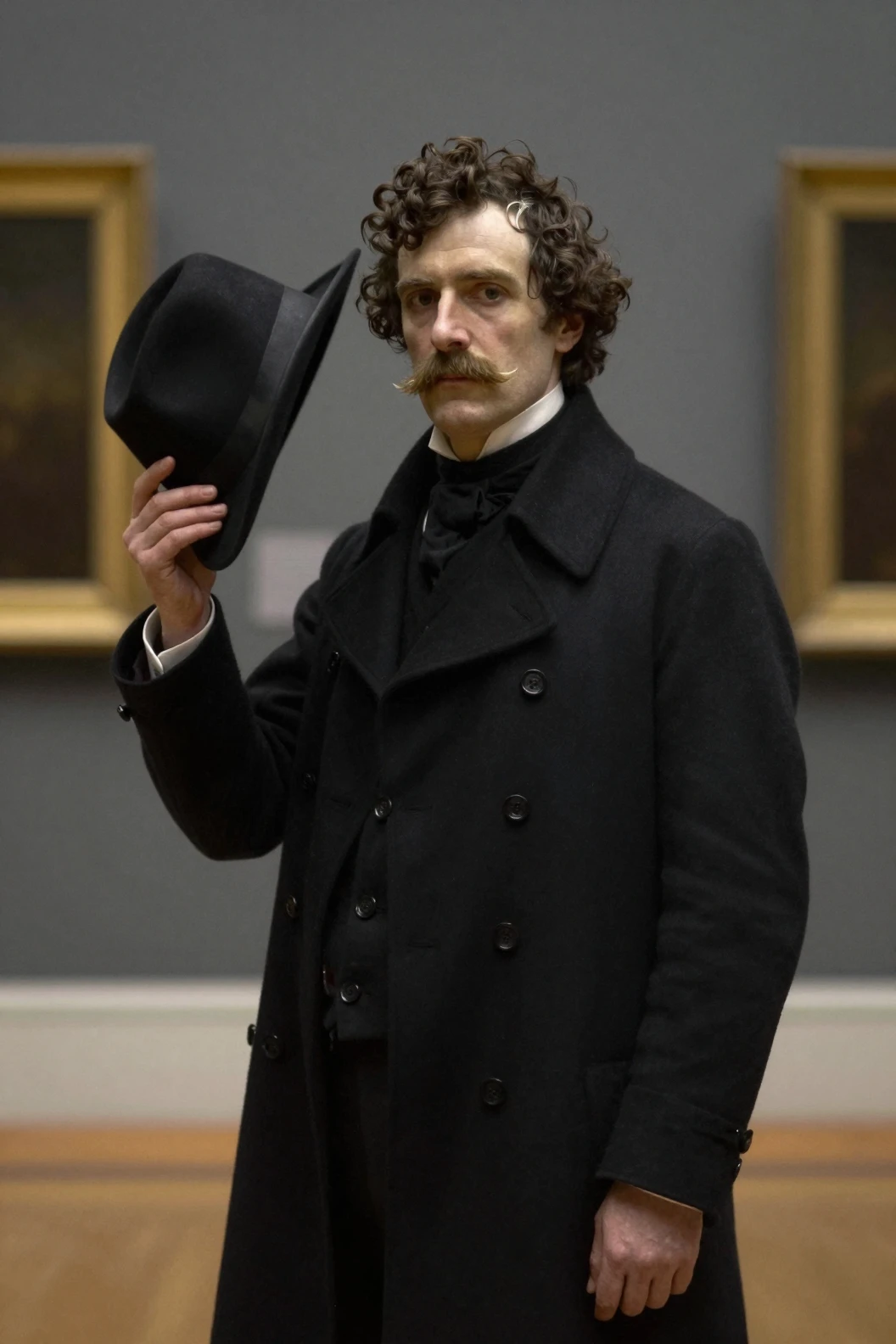
He was also one of the sharpest wits of the Victorian art world. When the critic John Ruskin accused him in 1877 of “flinging a pot of paint in the public's face”, Whistler sued for libel. The 1878 trial made his ideas famous, and in 1890 he collected his letters, pamphlets, and quarrels in The Gentle Art of Making Enemies. His belief in colour as pure expression links him with the visions of Claude Monet and Vincent van Gogh.
This collection contains 17 sentences taken from public-domain texts on Project Gutenberg: The Gentle Art of Making Enemies, including his pamphlet Art and Art Critics, his Propositions, and the trial testimony reprinted there, and Sadakichi Hartmann's The Whistler Book for his remarks on his own pictures. Each line is quoted exactly as printed.
17 Quotes from James McNeill Whistler
Critics and Criticism
“The truth is, as compared with his brother of the Boulevards, the Briton was badly begun by nature.”
Whistler opens fire with national comparison. In his view, the English public lacked the instinctive feeling for art found in Paris, and he used that claim to explain why British critics had so much to say and so little to see. In practice, the remark was also a jab at the critics who wrote about art in newspapers without ever lifting a brush.
“Still, quite alone stands Ruskin, whose writing is art, and whose art is unworthy his writing.”
A typical Whistler compliment with a sting. He admires Ruskin's prose and denies the quality of his painting. The sentence shows how personal the quarrel was and how elegantly he could wound. Ruskin was the most powerful critic in Britain, so a public quarrel with him was bold, and Whistler enjoyed it.
“That writers should destroy writings to the benefit of writing is reasonable.”
If critics are writers, he says, they may judge writing. Painting is another matter. The line is part of his argument that only the practising artist has the authority to judge a painter. The argument has not disappeared; debates about who has the right to judge a work still follow his logic.
“No! let there be no critics!”
A famous cry from Art and Art Critics. Whistler argues that criticism by non-painters leads the public astray. The exclamation is part provocation and part sincere belief that art should be judged by artists. Whistler enjoyed the showmanship of the sentence, and the public enjoyed reading it, which made it more effective than a calm argument.
“I hold that none but an artist can be a competent critic.”
Stated in court, this is his central principle. A person who has never struggled with a canvas does not know its difficulties. The statement was controversial then and is still debated now. Opinions differ about whether this is true, yet the statement forces us to ask what qualifies someone to judge.
Art, Harmony, and the Picture
“That in Art, it is criminal to go beyond the means used in its exercise.”
From his Propositions. An artist should stay within the limits of the medium. Whistler admired economy: a few tones, a few lines, chosen with care, and nothing more than the picture needs. He applied it to his own work: his portraits and nocturnes are famous for what they leave out.
“That the space to be covered should always be in proper relation to the means used for covering it.”
Another proposition on proportion. A small gesture on a large surface wastes the space; a heavy treatment on a small one overwhelms it. Whistler asks for balance between means and scale. It is a lesson in design as much as in painting, and it applies to anything that is arranged, from a page to a room.
“My whole scheme was only to bring about a certain harmony of colour.”
Asked in court about his Nocturne in Black and Gold, he explains that he wanted harmony, not a map of fireworks. It is the clearest summary of his aesthetic: the picture is an arrangement of colour and tone. Hearing this in a courtroom, Victorian jurors were confronted with a view of painting very different from the story pictures they knew.
“It is an artistic arrangement.”
Four words that capture his whole outlook. A painting is something arranged, not copied. The sentence also explains why he gave his works titles such as Arrangement and Harmony. He took the same approach to titles, often naming paintings after musical ideas to signal that the subject was secondary.
The Public and Taste
“Modesty and good sense are revolted at nothing, and the millennium of ‘Taste’ sets in.”
A satirical sentence on the rule of fashion. When people stop trusting their own eyes, Whistler argues, they accept whatever critics call tasteful. It is a warning about borrowed opinions. It reads like a joke, but the target is serious: a society that trusts fashion over its own senses.
“Eloquence alone shall guide them—and the readiest writer or wordiest talker is perforce their professor.”
He mocks the notion that the best talker must be the best judge. Fluency, he says, is not knowledge. The public follows the loudest voice instead of its own perception. His own career, built on writing and talking as well as painting, makes the irony all the sharper.
“As to what the picture represents that depends upon who looks at it.”
The viewer matters. Whistler refuses to give a fixed explanation of his Nocturne, since each person will find something different. The statement anticipates modern ideas about interpretation. Modern viewers of abstract art will recognise the position, in which meaning is shaped partly by whoever stands in front of the work.
“To some persons it may represent all that is intended; to others it may represent nothing.”
Some will see what he meant, others will see nothing at all, and he accepts both outcomes calmly. The line shows how confident he was in the independence of his art. He accepted that not everyone would care for his experiments, and he did not try to force agreement.
Wit, Defiance, and the Artist's Life
“I don’t mind having enemies where I can get at them.”
Said in a conversation about America, this is classic Whistler. He enjoyed a visible opponent and a public quarrel more than quiet disapproval from a distance. The remark shows his instinct for the open fight, which made him both a difficult colleague and an entertaining figure.
“A good many people in America don’t like me, and I am not there to fight them as I can fight my enemies here.”
He admits that distance blunts his weapons. The remark is playful but also reveals how seriously he took his reputation and how much he enjoyed the contest. The words carry humour and a hint of loneliness, since fame had made him a target for many unfriendly critics.
“I don’t own my pictures.”
A short comment with a larger meaning. Once sold, a painting belongs to its buyer. Whistler accepted that his work had gone out into the world and would be seen by people he would never meet. Selling a painting, to him, meant letting it go, and he valued the idea that the work should have its own life.
“I sold most of them long ago to people who think more of them than they do of me.”
A dry joke about his collectors. Whistler suggests that his pictures were more valued than their maker, and he says it with a smile. The remark reflects both pride and amusement. He enjoyed puncturing the reverence of collectors, and the remark shows he did not take himself too solemnly.
Conclusion
Whistler's words reveal a painter who defended the independence of art with wit and stubbornness. He insisted that a picture is an arrangement of colour and tone, that technique should disappear into effect, and that knowledge earned over a lifetime deserves respect.
He won the libel case, but the jury awarded him only a farthing in damages, and the legal costs contributed to his bankruptcy the following year. Even so, his ideas prevailed. Today Arrangement in Grey and Black No. 1 hangs in the Musée d'Orsay in Paris, and his insistence that art need not tell a story helped prepare the way for modern painting.
Frequently Asked Questions
Who was James McNeill Whistler?
James McNeill Whistler (1834–1903) was an American painter and printmaker who worked in London and Paris. He is known for Arrangement in Grey and Black No. 1 and for his Nocturnes.
What was the Whistler v. Ruskin trial?
In 1877 John Ruskin criticised Whistler's Nocturne in Black and Gold: The Falling Rocket. Whistler sued for libel in 1878. He won, but was awarded only one farthing in damages.
What is “The Gentle Art of Making Enemies”?
It is Whistler's 1890 collection of letters, pamphlets, and comments on his disputes with critics and rivals. It is available in the public domain on Project Gutenberg, which is where this article draws most of its quotations.
Which text is quoted here?
He believed painting should be judged for harmony of colour and form, as music is judged for harmony of sound. Titles such as Nocturne, Symphony, and Arrangement told viewers not to look for a story.
Recommended Similar Collections on Quotyzen
- Claude Monet – Father of Impressionism
- Vincent van Gogh – Visionary of Color and Emotion
- Claude Debussy – Revolutionary Painter of Sound
Do you think only an artist can judge art? Share your view in the comments below!
Join the conversation