
The Visionary Legacy of Ada Lovelace
Ada Lovelace (1815–1852), Augusta Ada King, Countess of Lovelace, was an English mathematician and the daughter of the poet Lord Byron. She is remembered for her work with Charles Babbage and for the notes she added in 1843 to a translation of an article on his Analytical Engine. The portrait on this page is an AI-generated illustration, not a historical likeness.
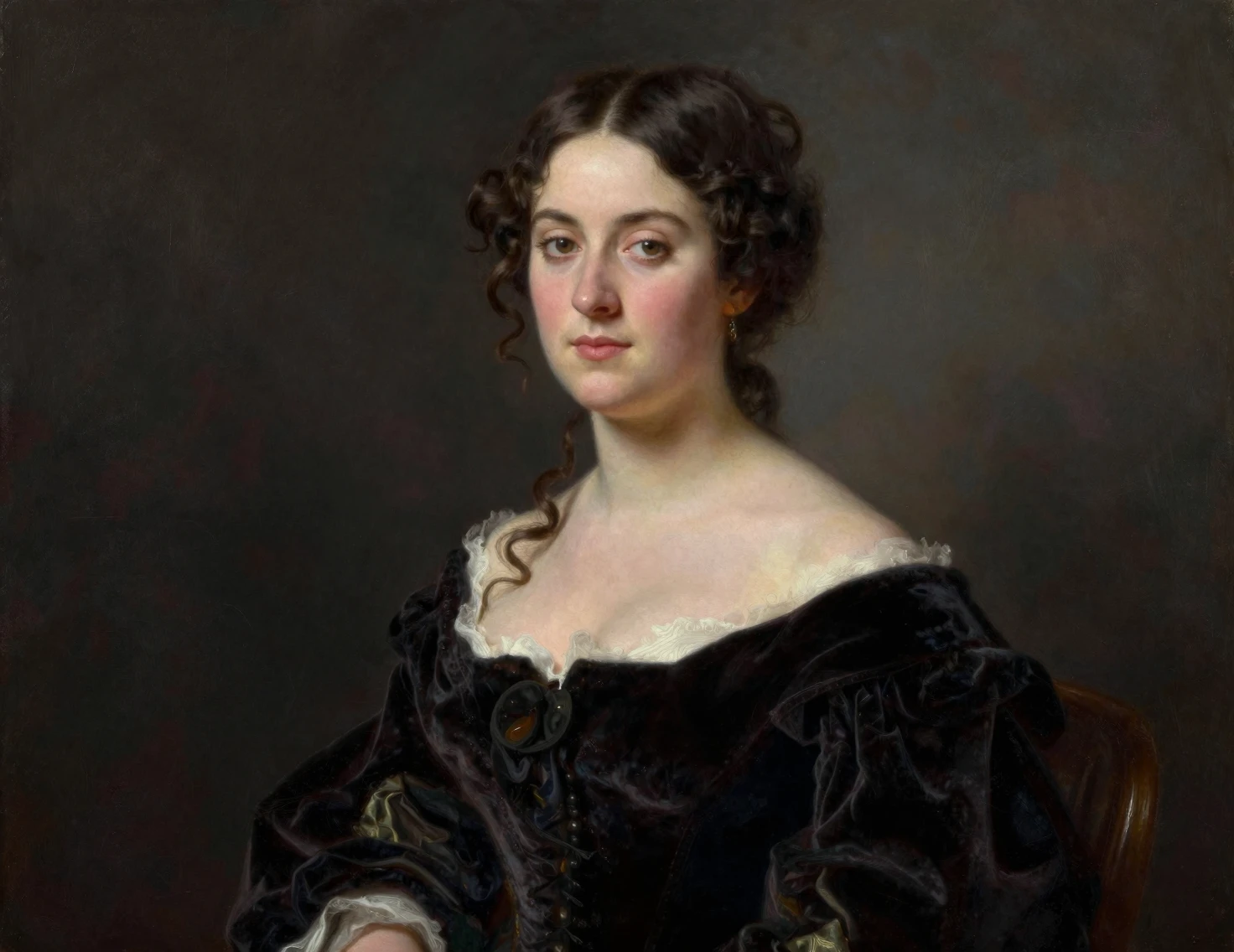
The sentences below come from those notes. She translated Luigi Menabrea’s memoir on the engine from French and added notes signed A.A.L. that were longer than the memoir itself. Readers of our pages on Charles Babbage: The Father of the Computer and Visionary of the Digital Age, Gottfried Wilhelm Leibniz: The Polymath of Optimism and Infinite Calculus and Henri Poincaré: The Last Universalist of Mathematics will find more voices from the same world.
This collection contains 17 sentences written by Lovelace herself, taken from the Notes by the Translator in the 1843 English version of Menabrea’s Sketch of the Analytical Engine, Project Gutenberg eBook 75107. The notes were written in English, so no translation is involved. Each sentence was checked word for word against that text, and sentences with missing mathematical symbols were left out.
17 Sentences from Ada Lovelace’s Notes on the Analytical Engine
The Engine and the Loom
““We may say most aptly that the Analytical Engine weaves algebraical patterns just as the Jacquard-loom weaves flowers and leaves.””
This is the best known image in Lovelace’s notes. The Jacquard loom used punched cards to weave patterns in silk, and she says that the Analytical Engine weaves algebraical patterns in the same way. The comparison explains a difficult machine through a familiar one: the cards control the work, so a pattern, whether of flowers or of algebra, comes from instructions given in advance.
““The Analytical Engine has no pretensions whatever to originate any thing. It can do whatever we know how to order it to perform.””
Lovelace warns against exaggerated ideas about the engine. It does not originate anything; it does whatever we know how to order it to perform. She writes this to correct both overstatement and the reaction against it. The sentences set a clear limit that is still discussed in debates on machine intelligence: the machine follows instructions, and the originality belongs to the person who writes them.
““It can follow analysis; but it has no power of anticipating any analytical relations or truths. Its province is to assist us in making available what we are already acquainted with.””
Lovelace continues her account of what the engine can and cannot do. It can follow analysis, she says, but it cannot anticipate any analytical relations or truths. Its province is to help us make available what we already know. The sentences give the machine a precise role as an assistant, one that carries out known procedures quickly and accurately, and leaves discovery to human minds.
““Supposing, for instance, that the fundamental relations of pitched sounds in the science of harmony and of musical composition were susceptible of such expression and adaptations, the engine might compose elaborate and scientific pieces of music of any degree of complexity or extent.””
Here Lovelace imagines that a machine for numbers might handle other subjects. If the relations of pitched sounds in harmony could be expressed in its notation, she says, the engine might compose elaborate and scientific pieces of music of any complexity or extent. The sentence is conditional, but it shows that she saw the machine as a general manipulator of symbols, not merely a calculator.
The Science of Operations
““But the science of operations, as derived from mathematics more especially, is a science of itself, and has its own abstract truth and value; just as logic has its own peculiar truth and value, independently of the subjects to which we may apply its reasonings and processes.””
Lovelace argues that operations form a science of their own. Derived above all from mathematics, it has its own abstract truth and value, just as logic does, independent of the subjects to which it is applied. The idea explains why a machine built for numbers can deal with more than numbers. If processes can be described apart from their subject matter, a machine can carry them out.
““The Analytical Engine is an embodying of the science of operations, constructed with peculiar reference to abstract number as the subject of those operations.””
Lovelace gives a compact definition. The Analytical Engine embodies the science of operations, built with abstract number as its subject. The sentence links her theory to Babbage’s machine: the engine is not a single trick but a physical form of a general science. She then contrasts it with the Difference Engine, which embodies only one limited set of operations.
““In enabling mechanism to combine together general symbols, in successions of unlimited variety and extent, a uniting link is established between the operations of matter and the abstract mental processes of the most abstract branch of mathematical science.””
Lovelace names the importance of the engine in one long sentence. By letting a mechanism combine general symbols in successions of unlimited variety and extent, she says, a uniting link is made between the operations of matter and the abstract mental processes of mathematics. The phrase describes what later computers made familiar: abstract rules carried out by physical parts.
““A new, a vast, and a powerful language is developed for the future use of analysis, in which to wield its truths so that these may become of more speedy and accurate practical application for the purposes of mankind than the means hitherto in our possession have rendered possible.””
Lovelace looks ahead to the effect on mathematical analysis. The engine, she says, develops a new, vast and powerful language in which truths can be applied more quickly and accurately for the purposes of mankind than before. She treats the machine as a language as well as a device, a way of writing procedures so that they can be carried out without error and at speed.
““We are not aware of its being on record that anything partaking in the nature of what is so well designated the Analytical Engine has been hitherto proposed, or even thought of, as a practical possibility, any more than the idea of a thinking or of a reasoning machine.””
Lovelace stresses how new the engine was. She says nothing like it had been proposed, or even thought of, as a practical possibility, any more than the idea of a thinking or reasoning machine. The sentence reflects her sense of the novelty of Babbage’s design. It also shows that the idea of a reasoning machine was already in the air in 1843, even as she rejects exaggerated claims.
Cards, Cycles and Algebra
““The Analytical Engine, on the contrary, can either add, subtract, multiply or divide with equal facility; and performs each of these four operations in a direct manner, without the aid of any of the other three.””
Lovelace compares the two engines. The Difference Engine can carry out only one particular series of operations, while the Analytical Engine can add, subtract, multiply or divide with equal facility, and does each of the four directly, without using the other three. The sentence names the feature that made the design general-purpose: any of the four operations can be called for when a calculation needs it.
““It should be remembered also that the cards when once made out for any formula, have all the generality of algebra, and include an infinite number of particular cases.””
Lovelace points out a benefit of the punched cards. Once they are made out for a formula, they have all the generality of algebra and include an infinite number of particular cases. A set of cards is therefore a general procedure, not a single calculation. Changing only the numerical data gives each new case, which is the idea behind a program that can be run with different inputs.
““Many persons who are not conversant with mathematical studies, imagine that because the business of the engine is to give its results in numerical notation, the nature of its processes must consequently be arithmetical and numerical, rather than algebraical and analytical.””
Lovelace corrects a common misunderstanding. People who do not know mathematics, she says, assume that an engine giving numerical results must work by arithmetic alone, when its processes are algebraical and analytical. The sentence is a reminder that outputs and methods are different things. A machine may print numbers while carrying out general rules about relations between quantities.
““The engine can arrange and combine its numerical quantities exactly as if they were letters or any other general symbols; and in fact it might bring out its results in algebraical notation, were provisions made accordingly.””
Continuing the same point, Lovelace says the engine can arrange and combine its numerical quantities exactly as if they were letters or other general symbols. It could even give results in algebraical notation if provisions were made. The sentence supports her view that the machine works with symbols, and that numbers are only one way of using it. It is one of the clearest statements of that idea in the notes.
““One essential object is to choose that arrangement which shall tend to reduce to a minimum the time necessary for completing the calculation.””
Lovelace explains what matters when the order of operations is chosen. Many arrangements are possible, and one essential object is to choose the one that reduces to a minimum the time needed to complete the calculation. This is the thinking behind programming and algorithm design: a correct sequence is not enough, because the best sequence also saves time, and the engine’s cost makes efficiency important.
““A cycle of operations, then, must be understood to signify any set of operations which is repeated more than once.””
Lovelace defines a term that anticipates a basic idea of programming. A cycle of operations is any set of operations repeated more than once. By naming the repeated group, she makes it possible to write a long calculation briefly: describe the cycle once and say how many times it runs. The definition is plain, and it describes what is now called a loop.
Two Engines Compared
““The Difference Engine is in its character exclusively synthetical, while the Analytical Engine is equally capable of analysis or of synthesis.””
Lovelace distinguishes the two machines by the kind of work they do. The Difference Engine is exclusively synthetical, building results up from given data, while the Analytical Engine is equally capable of analysis or of synthesis. The contrast explains why the later design mattered more. It could handle general algebraic work and was not limited to one fixed table-making method.
““Provided we know the series of operations to be gone through, that is sufficient.””
This short sentence states a key condition of her approach. For the engine to do its work, we need only know the series of operations to be gone through. The numbers themselves can be supplied later. It puts the emphasis on the method, not on the particular answer, and it explains why her notes are often cited in the history of programming.
Conclusion
Read together, these sentences show Lovelace as a clear thinker about what a computing machine is. She calls the engine an embodiment of the science of operations, compares it to the Jacquard loom, notes that its cards hold the generality of algebra, and imagines that it might handle subjects beyond number, even music.
They also show her caution. She says the engine does not originate anything and only does what we know how to order it to perform. Both halves of that view, the wide reach of symbols and the limit set by instructions, are still used when people discuss what computers can do.
Frequently Asked Questions
Who was Ada Lovelace?
Ada Lovelace (1815–1852) was an English mathematician, the daughter of Lord Byron and Annabella Milbanke. She worked with Charles Babbage and is known for her 1843 notes on the Analytical Engine, which include an early published description of how such a machine could be programmed.
What are the Notes by the Translator?
In 1843 Lovelace translated an article by the Italian engineer Luigi Menabrea about Babbage’s Analytical Engine and added seven notes, labelled A to G. The notes are about three times as long as the article and contain her own ideas.
Are these sentences Lovelace’s own words?
Yes. The notes were written by Lovelace in English, so they are her own sentences, not a translation. Each one was checked word for word against the Project Gutenberg text, and passages with missing mathematical symbols were not used.
Which text is quoted here?
All 17 sentences come from the Notes by the Translator in Sketch of the Analytical Engine invented by Charles Babbage, Esq., by L. F. Menabrea, translated with notes by Ada Lovelace (1843), Project Gutenberg eBook 75107.
Recommended Similar Collections on Quotyzen
- Charles Babbage: The Father of the Computer and Visionary of the Digital Age – Sentences from Passages from the Life of a Philosopher.
- Gottfried Wilhelm Leibniz: The Polymath of Optimism and Infinite Calculus – Sentences from the Theodicy.
- Henri Poincaré: The Last Universalist of Mathematics – Sentences from The Foundations of Science.
Do you agree with Lovelace that a machine only does what we order it to do? Share your view in the comments below!
Join the conversation