
René Descartes: The Father of Modern Philosophy and Rationalism
René Descartes (1596–1650) was a French philosopher and mathematician who helped found analytic geometry and modern philosophy. His Discourse on the Method, published in 1637, describes how he rebuilt his beliefs from a single certainty. The portrait on this page is an AI-generated illustration, not a historical likeness.
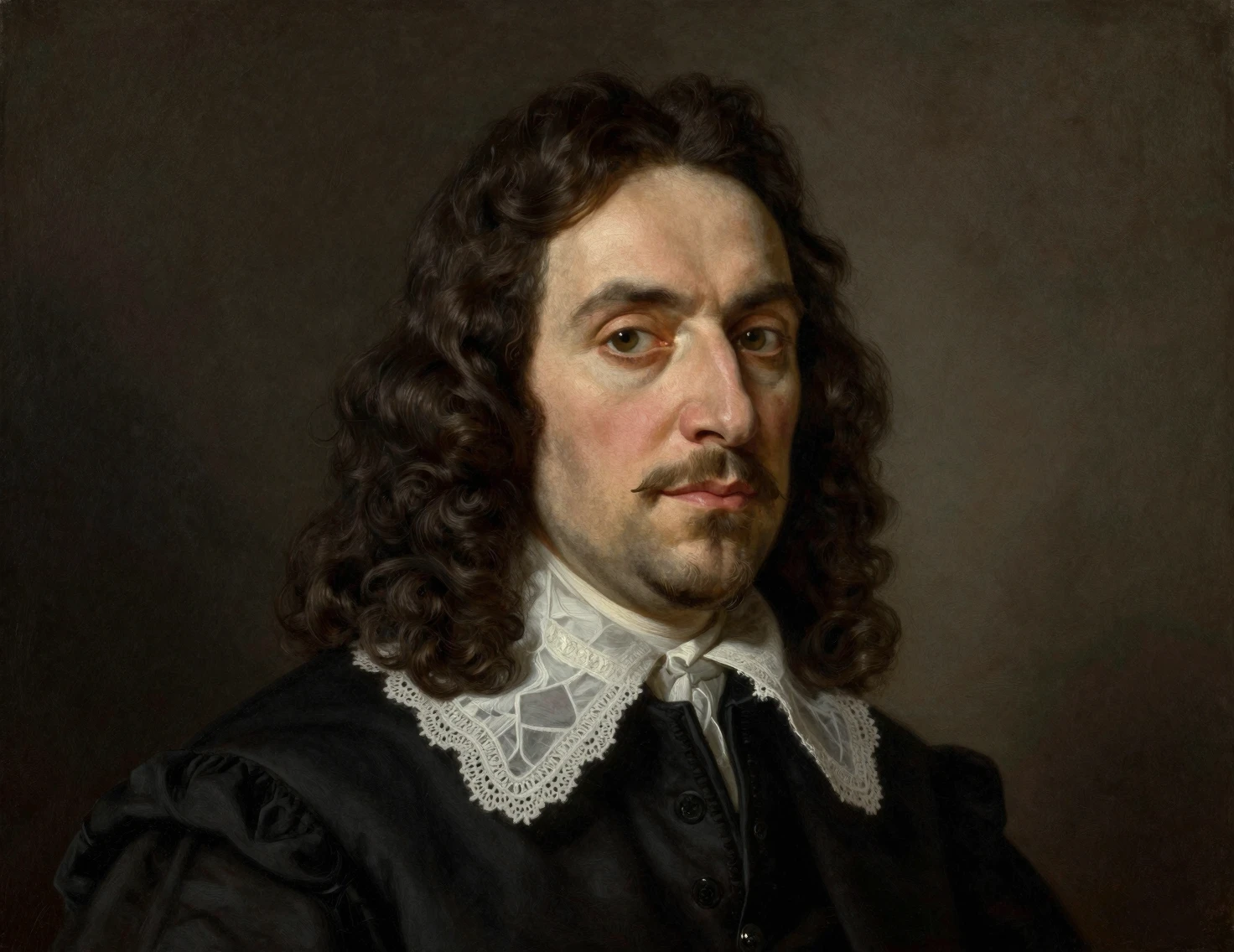
The sentences below come from the Discourse on the Method of Rightly Conducting One’s Reason and of Seeking Truth in the Sciences, in which Descartes tells the story of his own search and sets out the rules he followed. Readers of our pages on Blaise Pascal: The Mathematician of the Heart and the Infinite, Gottfried Wilhelm Leibniz: The Polymath of Optimism and Infinite Calculus and Galileo Galilei: The Father of Modern Science and the Starry Messenger will find more voices from the same world.
This collection contains 17 sentences written by Descartes himself, taken from the English translation by John Veitch, Project Gutenberg eBook 59. Each sentence was checked word for word against that text. Descartes wrote in French, so these are English translations, and the translator’s introduction is not included.
17 Sentences from Descartes’ Discourse on the Method
A Story, Not a Lecture
““My present design, then, is not to teach the method which each ought to follow for the right conduct of his reason, but solely to describe the way in which I have endeavored to conduct my own.””
Descartes begins by lowering the stakes. He does not claim to teach a method that everyone should follow, but only to describe how he has tried to conduct his own reason. The sentence sets the tone of the whole Discourse: it is a personal account of a search, offered openly to readers who may take from it what they find useful, instead of a set of commands.
““For I found myself involved in so many doubts and errors, that I was convinced I had advanced no farther in all my attempts at learning, than the discovery at every turn of my own ignorance.””
Descartes describes his disappointment after finishing his studies. He had found himself involved in so many doubts and errors that he had gained, he says, nothing but the discovery of his own ignorance at every turn. It is a striking admission from a student of one of the celebrated schools of Europe, and it explains why he later looked for a new foundation.
““For these reasons, as soon as my age permitted me to pass from under the control of my instructors, I entirely abandoned the study of letters, and resolved no longer to seek any other science than the knowledge of myself, or of the great book of the world.””
Descartes explains his decision to leave books behind. Once he was free from his instructors he abandoned the study of letters and resolved to seek no other science than the knowledge of himself, or of the great book of the world. He turned to travel, experience and his own reflection as sources of understanding, in addition to what he had read.
““In addition, I had always a most earnest desire to know how to distinguish the true from the false, in order that I might be able clearly to discriminate the right path in life, and proceed in it with confidence.””
Descartes states the desire that drives the whole project. He wanted to know how to distinguish the true from the false, so that he could see clearly the right path in life and walk it with confidence. The aim is practical as well as theoretical: knowledge is not an end in itself, but a way to act without hesitation.
Rebuilding on One’s Own Foundation
““Of these one of the very first that occurred to me was, that there is seldom so much perfection in works composed of many separate parts, upon which different hands had been employed, as in those completed by a single master.””
Descartes begins his reflections on method with an image from building. Works made of many separate parts, with different hands employed on them, are seldom as perfect as those completed by a single master. The comparison prepares his argument that knowledge too should be organised by a single mind, according to one plan, rather than patched together from many sources.
““I firmly believed that in this way I should much better succeed in the conduct of my life, than if I built only upon old foundations, and leaned upon principles which, in my youth, I had taken upon trust.””
Descartes explains why he chose to rebuild his beliefs from the start. He firmly believed that he would succeed better in the conduct of his life than if he built only on old foundations and relied on principles he had taken on trust in his youth. The image of foundations returns later when he searches for a first certainty.
““I have never contemplated anything higher than the reformation of my own opinions, and basing them on a foundation wholly my own.””
Descartes limits his ambition. He has never thought of anything higher than reforming his own opinions and basing them on a foundation wholly his own. The sentence shows that his project is personal, not political: he is not trying to overthrow institutions, only to examine and rebuild what he himself believes.
““I was thus led to infer that the ground of our opinions is far more custom and example than any certain knowledge.””
Descartes names a problem that holds back clear thinking. The ground of our opinions, he infers, is far more custom and example than any certain knowledge. We believe many things because everyone around us believes them. This is why he proposes to examine his own beliefs instead of accepting them because they are familiar.
““I could, however, select from the crowd no one whose opinions seemed worthy of preference, and thus I found myself constrained, as it were, to use my own reason in the conduct of my life.””
Descartes could find no one among his contemporaries whose opinions seemed worth preferring, so he felt constrained to use his own reason in the conduct of his life. The sentence is the practical result of his doubt about authority. It does not claim that others are always wrong, but that he cannot rely on them to settle the question.
““But like one walking alone and in the dark, I resolved to proceed so slowly and with such circumspection, that if I did not advance far, I would at least guard against falling.””
Descartes describes his attitude in a famous image: he is like one walking alone and in the dark. He decides to proceed so slowly and with such circumspection that, even if he does not advance far, he will at least guard against falling. The sentence presents caution as a deliberate method, which makes progress slow but secure.
The Rules of the Method
““The first was never to accept anything for true which I did not clearly know to be such; that is to say, carefully to avoid precipitancy and prejudice, and to comprise nothing more in my judgement than what was presented to my mind so clearly and distinctly as to exclude all ground of doubt.””
This is the first of Descartes’ four rules of method. He will never accept anything as true unless he clearly knows it to be so, and he will avoid hasty judgement and prejudice, including in his judgement only what presents itself so clearly and distinctly that no ground of doubt remains. The rule defines the standard of certainty for everything that follows.
““The second, to divide each of the difficulties under examination into as many parts as possible, and as might be necessary for its adequate solution.””
The second rule is to divide each difficulty into as many parts as possible, and as may be needed to solve it. It is the practical heart of his method. A problem that seems too large to approach can be broken into smaller questions, and each of these can be examined separately before the answers are put back together.
““And the last, in every case to make enumerations so complete, and reviews so general, that I might be assured that nothing was omitted.””
The last rule is to make enumerations so complete and reviews so general that nothing is omitted. Descartes pairs careful division with a final check of the whole. After analysing a question into parts, he wants to be assured that he has missed nothing. It is the habit of reviewing one’s work, built into the method.
““Not that in this I imitated the sceptics who doubt only that they may doubt, and seek nothing beyond uncertainty itself; for, on the contrary, my design was singly to find ground of assurance, and cast aside the loose earth and sand, that I might reach the rock or the clay.””
Descartes separates his doubt from scepticism. The sceptics, he says, doubt only for the sake of doubting and seek nothing beyond uncertainty, while his design was to find ground of assurance and cast aside the loose earth and sand to reach the rock or clay. Doubt is a tool for reaching certainty, not a conclusion.
I Think, Therefore I Am
““I had long before remarked that, in relation to practice, it is sometimes necessary to adopt, as if above doubt, opinions which we discern to be highly uncertain, as has been already said; but as I then desired to give my attention solely to the search after truth, I thought that a procedure exactly the opposite was called for, and that I ought to reject as absolutely false all opinions in regard to which I could suppose the least ground for doubt, in order to ascertain whether after that there remained aught in my belief that was wholly indubitable.””
Descartes describes his procedure of radical doubt. For the search after truth he decides to reject as absolutely false every opinion in which he can suppose the least ground for doubt, in order to see whether anything wholly indubitable remains in his belief. It is a deliberate test that sets a very high bar, and it prepares the discovery that follows.
““But immediately upon this I observed that, whilst I thus wished to think that all was false, it was absolutely necessary that I, who thus thought, should be somewhat; and as I observed that this truth, I think, therefore I am (COGITO ERGO SUM), was so certain and of such evidence that no ground of doubt, however extravagant, could be alleged by the sceptics capable of shaking it, I concluded that I might, without scruple, accept it as the first principle of the philosophy of which I was in search.””
This is the sentence in which the famous phrase appears. While trying to think that everything is false, Descartes observes that he who thinks must be something, and that the truth I think, therefore I am is so certain that no extravagant doubt of the sceptics can shake it. He accepts it as the first principle of his philosophy.
““And as I observed that in the words I think, therefore I am, there is nothing at all which gives me assurance of their truth beyond this, that I see very clearly that in order to think it is necessary to exist, I concluded that I might take, as a general rule, the principle, that all the things which we very clearly and distinctly conceive are true, only observing, however, that there is some difficulty in rightly determining the objects which we distinctly conceive.””
Descartes examines why the first certainty is certain. In the words I think, therefore I am, he sees nothing that assures their truth except that he sees very clearly that to think it is necessary to exist. From this he takes a general rule: what we conceive very clearly and distinctly is true, with the caution that it can be hard to judge which things we conceive distinctly.
Conclusion
Read together, these sentences show Descartes explaining a method instead of announcing a doctrine. He admits his ignorance, decides to rebuild his beliefs on his own foundation, sets four rules, and tests everything by doubt. The tone is cautious, personal and clear.
They also show where the famous phrase comes from. It is not offered as a slogan, but as the first thing that survives his doubt. From that point he reasons that what is conceived very clearly and distinctly can be taken as true, while admitting that this is not always easy to judge.
Frequently Asked Questions
Who was René Descartes?
René Descartes (1596–1650) was a French philosopher, mathematician and scientist. He is often called the father of modern philosophy, and he contributed to analytic geometry, which joins algebra and geometry.
What is the Discourse on the Method?
It is the short book published in 1637 in which Descartes describes his education, his doubts, his four rules of method and his first certainty, I think, therefore I am. It served as an introduction to scientific essays that were printed with it.
Are these sentences Descartes’ own words?
They are his own sentences in English translation. Descartes wrote the Discourse in French, so the wording belongs to the translator, John Veitch. The translator’s introduction and notes are not included.
Which text is quoted here?
All 17 sentences come from the Discourse on the Method of Rightly Conducting One’s Reason and of Seeking Truth in the Sciences, translated by John Veitch, Project Gutenberg eBook 59.
Recommended Similar Collections on Quotyzen
- Blaise Pascal: The Mathematician of the Heart and the Infinite – Sentences from the mathematician who weighed reason against the heart.
- Gottfried Wilhelm Leibniz: The Polymath of Optimism and Infinite Calculus – Sentences from the philosopher who dreamed of a universal calculus.
- Galileo Galilei: The Father of Modern Science and the Starry Messenger – Sentences from his first telescope observations.
Which of Descartes’ four rules do you find most useful in your own thinking? Share your view in the comments below!
Join the conversation